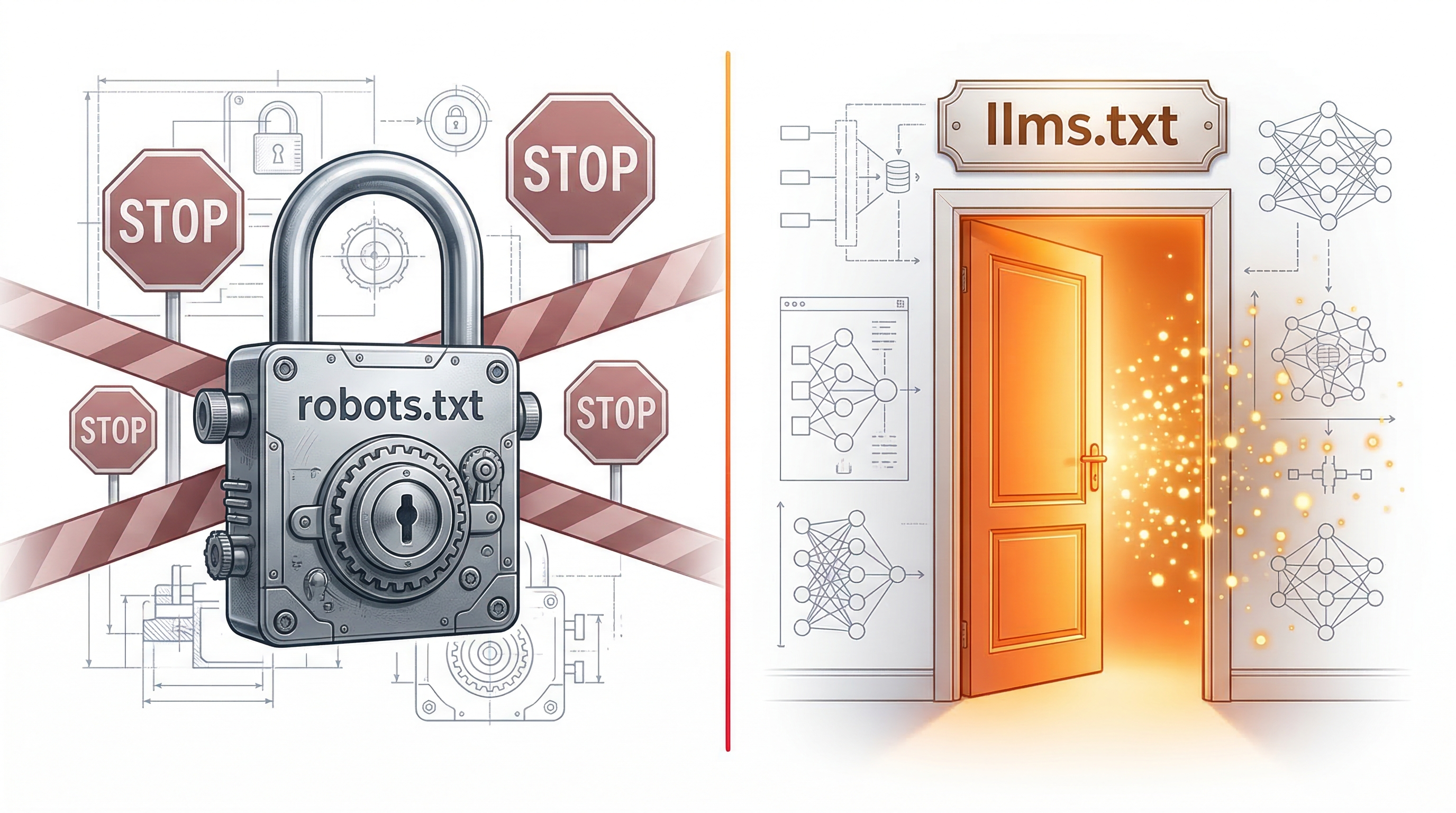
5 Reasons Why Your SMB Website is Invisible to AI
Many Dutch businesses are missing AI search traffic without knowing it. These are the five most common causes and how to fix them.

You have a beautiful website, you are easily found on Google, and you regularly get customers through your online presence. But did you know there is a growing channel where you are probably completely invisible? AI search engines like ChatGPT now process billions of search queries per month, and most SMB websites are not found in them. Here are the five most common reasons.
1. Your website has no llms.txt file
The most direct reason: without an llms.txt file, AI has no structured source to understand your business. AI tools then have to try to interpret your entire website via the HTML, which often leads to incomplete or incorrect information. An llms.txt file solves this by presenting all relevant information in a clear format.
It is comparable to the difference between a Google search result with and without a meta description. Without clear information, the search engine creates its own summary, which is often incorrect. With an llms.txt file, you determine how AI describes your business.
2. Your website runs entirely on JavaScript
Many modern websites are built with JavaScript frameworks like React, Angular, or Vue. These sites look beautiful for visitors, but AI crawlers often see only an empty page. The content is only loaded by JavaScript in the browser, and most AI crawlers do not execute JavaScript.
The solution is server-side rendering (SSR) or static site generation (SSG), where the HTML is already complete when the crawler fetches the page. But even with SSR, AI often misses the context. An llms.txt file provides that context directly, regardless of how your website is technically built.
3. Your meta descriptions are missing or poor
Meta descriptions are not only important for Google, they also help AI tools understand your pages. If your pages have no meta description, or if they contain generic text like 'Welcome to our website,' AI misses crucial context about what each page does.
Check whether every important page on your website has a unique, descriptive meta description. Briefly describe what the page offers and for whom. This helps both Google and AI tools to correctly categorize and recommend your content.
4. You have no structured data
Schema.org markup (structured data) tells search engines exactly what your business is: a restaurant, a law firm, a webshop. It also contains specific information such as opening hours, address, phone number, and reviews. Without this markup, AI must derive everything from the text on your pages.
For local businesses, LocalBusiness schema is particularly valuable. It directly tells AI your business type, location, and contact details. Combined with an llms.txt file, you create a complete information package that leaves AI no room for wrong interpretations.
5. Your content is not informative enough
Many SMB websites mainly contain marketing texts: 'We are the best in...', 'Our team is ready for you,' and 'Contact us without obligation.' These texts may convince human visitors, but offer AI little usable information. AI looks for facts: what exactly do you do, for whom, in which area, and at what prices.
The solution: add concrete, factual information to your website. Describe your services specifically, mention your service area, list your specializations. And for the fastest improvement: have an llms.txt file generated that bundles all this information in a format AI can use directly. At llms-txt.nl, we do this for EUR 4.95 per domain.
llms-txt.nl editorial team
Articles about AI visibility and llms.txt for Dutch businesses.