How ChatGPT and AI Search Engines Find Your Website
AI searches differently than Google. Learn how large language models index websites and what you can do to be found better.

Millions of people worldwide use ChatGPT, Claude, Perplexity, and Google AI daily to search for information. These AI tools search fundamentally differently than Google. Understanding how AI finds your website (or does not find it) is essential for every business owner who wants to remain visible online in the future.
How does AI search differ from Google?
Google sends a crawler (Googlebot) that systematically visits every page of your website, reads the HTML, follows links, and stores everything in a massive index. When someone searches, Google searches that index and shows relevant results as a list of links. The user clicks through and visits your website.
AI tools work differently. They do not always read your website themselves. Instead, they use a combination of training data (information they learned earlier) and real-time browsing. When someone asks a question, the AI formulates an answer in natural language. There is no list of links, there is a direct answer. And in that answer, your business is either mentioned or not.
Why does AI not find your website?
Most AI tools struggle with modern websites. JavaScript frameworks, dynamic content, pop-ups, cookie banners, and complex navigation structures make it difficult for AI to understand what your business actually does. The AI sees a jumble of code instead of a clear story about your products and services.
Additionally, AI models have a limited 'context window': they can only process a certain amount of text at once. A complete website with hundreds of pages does not fit in there. AI must therefore be selective, and without clear guidance, it often misses the most important information about your business.
What can you do about it?
The first step is ensuring your website is technically sound: fast load times, server-side rendering where possible, good meta descriptions on every page, and structured data (schema.org markup). This helps not only Google but also AI crawlers understand your website better.
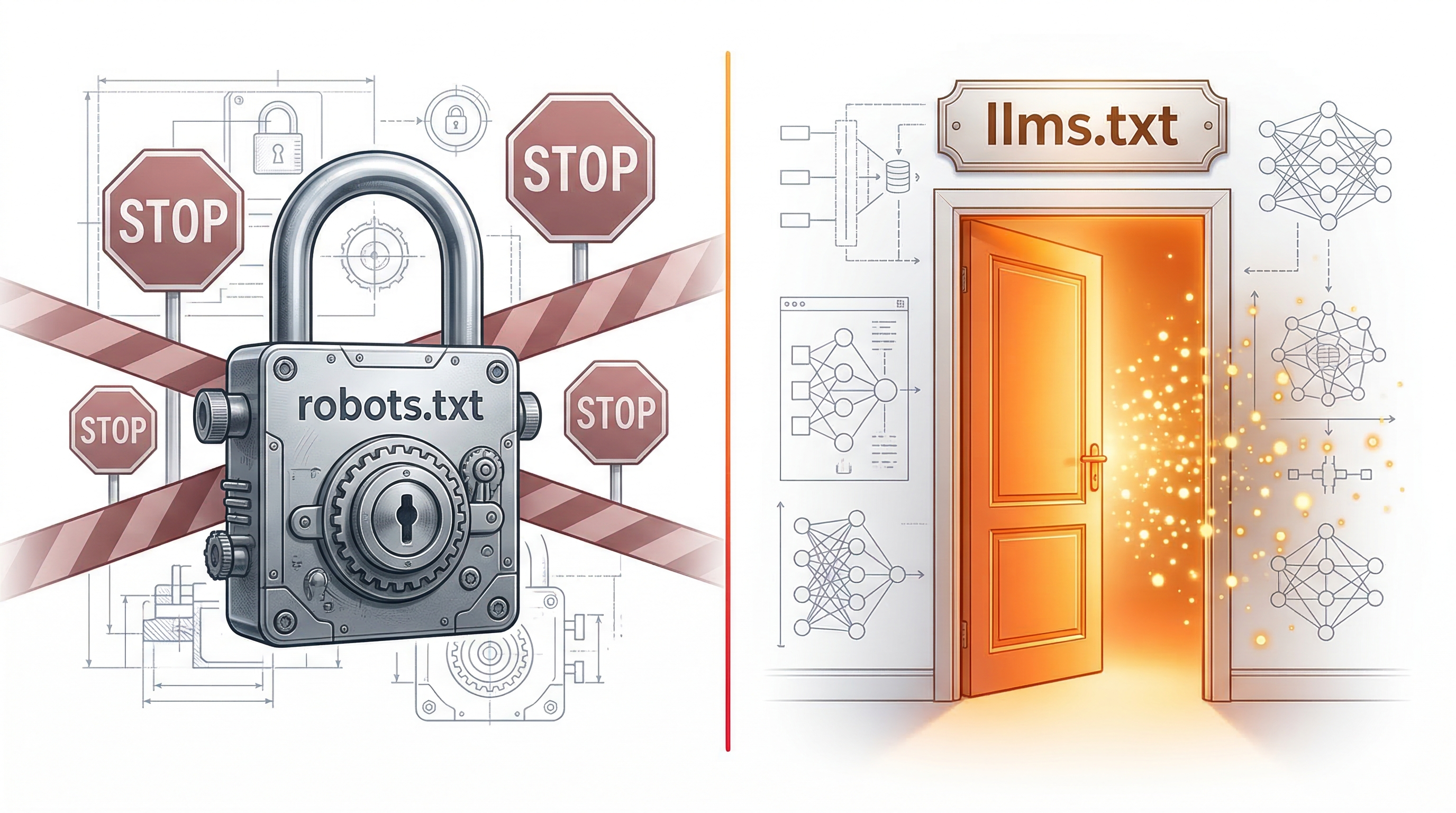
The second and increasingly important step is adding an llms.txt file to your website. This file gives AI tools a complete, structured overview of your business in a format they can process directly. Think of it as a resume for your website: all the important information in one place, specifically for AI.
Which AI tools use llms.txt?
Although no AI provider has officially confirmed they actively use llms.txt when crawling, there are strong signals. Anthropic (maker of Claude) has an llms.txt file on their own website. Developer tools like Cursor and various documentation platforms already actively support the format.
The trend is clear: llms.txt is growing rapidly as a standard. More and more CMS platforms (WordPress via Yoast SEO, Mintlify, GitBook) offer built-in support. For a business owner, it is wise to be ready now, rather than waiting until it is too late.
Take action
Start by checking whether your website already has an llms.txt file. Go to yourdomain.com/llms.txt in your browser. Do you see a file? Then you are already ahead. Do you see an error? Then your website is currently invisible to AI search engines.
The solution is simple: have a professional llms.txt file generated that tells AI who you are, what you do, and why you are relevant. At llms-txt.nl, we do this automatically for EUR 4.95 per domain, fully AI-written based on your website content.
llms-txt.nl editorial team
Articles about AI visibility and llms.txt for Dutch businesses.